The renovation of the swimming pool at the Hotel Excelsior Palace in Rapallo, with the construction of corrugated steel floor slabs and a steel frame. A description of the project and the modelling.
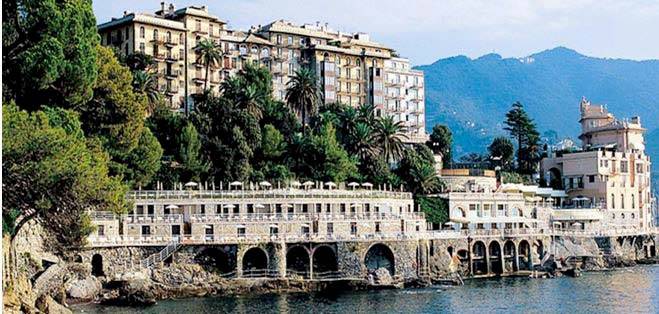
Figura 1 - Vista ovest della zona a mare facente parte dell’hotel

The following describes the structural works carried out by Studio O&M Ingegneria for the renovation of various parts of the Hotel Excelsior Palace in Rapallo, a 5-star hotel overlooking the Gulf of Tigullio, which enjoys a striking view of the bay and the Portofino headland. This major building enjoys a strategic position on the road leading to Santa Margherita Ligure and Portofino, a location that places it at the heart of an area with a strong tourist appeal.
Studio O&M Ingegneria was called in to carry out the renovation of various structural parts of the hotel's wellness centre; drawing on the experience gained from frequently working on special projects in industrial environments and also in difficult natural settings, it approached the task with careful planning and the use of innovative technologies. The main challenges encountered concerned the close interconnection between the structures to be worked on and the neighbouring ones — some belonging to other owners, for whom it was necessary to prevent any change in the static and stress regime — the location of the structure, which makes the management and logistics of personnel and equipment very difficult, and further complexities arising from the geology of the project area and the seismicity of the region.
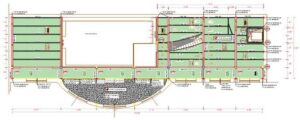
The following describes the works that concerned the steel and reinforced concrete structures in the area known as the "emiciclo" (semicircle) and that, in particular, involved the renovation of the existing outdoor swimming pool, located on the top floor of the hotel, and the construction of floor slabs and steel frames in the area beneath the semicircle to support the pool itself.
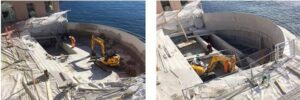
The choice to describe in detail the types of structural works that concerned only this area of the complex relates to the enormous difficulties encountered during execution, given that the construction site extended over a difficult area to supply, as it is a cliff enclosed between the sea and the provincial road.
Also worth mentioning is the calculation method and the structural modelling, which was carried out with the aid of DOLMEN, a calculation software of proven reliability that makes it possible to perform a detailed analysis of the behaviour of the entire structure, taking into account the stiffening behaviour of even complex walls and of floor slabs, considered with their actual rigidity.
The wellness centre was affected by the demolition of the automated car park, the construction of two intermediate floor slabs in corrugated steel and a metal frame, and the renovation of the outdoor swimming pool.
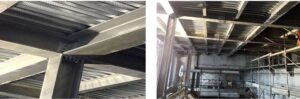
Beneath the outdoor pool, on the top floor of the seafront portion of the hotel, there was a mechanised garage that partly extended beneath the adjacent building, known as the Kursaal. The garage had been earmarked to house new services for the hotel's guests; consequently, since it had reduced floor-to-floor heights, it needed to be cleared of its load-bearing structures and replaced with new members suited to the new internal layout and therefore to the new intended use. The first and second floors were thus affected by the construction of new corrugated steel floor slabs; in particular, the EGB/210 D sheet was chosen, with a height of 55 mm, a thickness of 1.2 mm and an average spacing between the grooves of 150 mm; the overall thickness of the slab (concrete and corrugated steel sheet) is 125 mm.
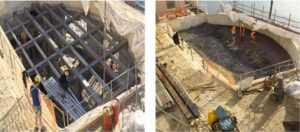
To support the intermediate floor slabs and the outdoor pool with its mixed steel-concrete base, a new steel frame was built, formed by a grid of HEB 240 main beams for the intermediate floors and HEB 220 main beams. The secondary beams for the intermediate floors are IPE 160 or IPE 200; the main beams are supported by steel columns (HEB 240 or HEB 280) that were anchored to the rocky bed of the building.
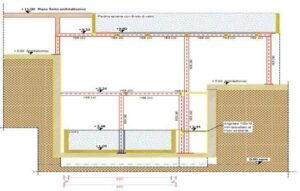
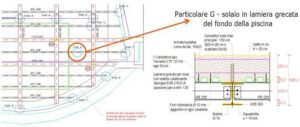
The top floor underwent the renovation of the existing pool; the work involved the demolition and subsequent replacement of the base of the existing open-air pool by means of a mixed steel-concrete structure consisting of a corrugated steel sheet onto which a concrete casting was carried out.
The sheet acts as formwork during construction and constitutes the longitudinal reinforcement after the concrete has hardened. The corrugated steel sheets were supported by a grid of steel beams anchored to the reinforced concrete walls; HEB 260 sections were used for the main beams and IPE 200 sections for the secondary beams; the concrete casting has an overall thickness of 30 cm.
To make the reinforced concrete slab integral with the steel main beams, shear connectors were installed with a diameter of 20 mm and a height of 20 cm, at 50 cm spacing. The reinforced concrete slab was reinforced top and bottom with 14 mm diameter bars at 20 cm spacing, in both the longitudinal and transverse directions; at the beam-column nodes, the reinforcement was densified by adding 16 mm diameter bars at 20 cm spacing.
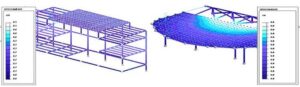
The structural works were modelled using the finite element method, applied to three-dimensional systems; the elements used are both one-dimensional (columns) and two-dimensional (plates).
The structure was schematised excluding the contribution of elements with stiffness and strength that are negligible compared to the main ones. The solution of the statically indeterminate problem yielded, as results, the constraint reactions at the external restraints, the stresses Mx, My, Mxy, Sx, Sy, Sxy of all the shells making up the system, and the stresses N, Tz, Ty, Mx, My, Mz of all the beam elements.
The S355 steel members were all modelled as beams, while the strength of the corrugated steel sheet and of the mixed steel-concrete construction system was considered to be nil. The sheet was consequently treated in the calculation as formwork supporting the reinforced concrete slab; this choice was made on the side of safety.
The study of the behaviour of the building and the pool was developed by analysing the structure and the pool under the effect of gravitational and seismic loads, considering the most unfavourable load conditions. In this way it was possible to calculate the maximum vertical and seismic displacements in the two principal directions; the results obtained by observing the horizontal displacements in the two directions are entirely compatible with the structure analysed.
In addition, buckling checks were carried out on all the steel sections, and these were found to be satisfactory.
As for the floor slab, it consists of a corrugated steel sheet 1.2 mm thick and 55.0 mm high, onto which a reinforced concrete casting 45.0 mm thick is carried out, reaching an overall slab thickness of 70 mm, which will rest on the main beams below.
The sheet is made composite with the concrete by means of embossments capable of anchoring the casting, preventing both horizontal sliding and vertical separation. During casting, until the concrete has reached an adequate level of curing (phase 1), the self-weight of the concrete, the personnel and the equipment used is supported by the sheet alone. Once the concrete has cured (phase 2), the sheet and the concrete form a homogenised section with all the characteristics of traditional reinforced concrete floor slabs, where the sheet, having fulfilled the function of formwork, takes on — for the positive moments — that of metal reinforcement. In order to increase the strength of the entire slab, a 12 mm diameter bar was added in the tension zone in each channel for the whole floor slab, while in the compression zone an electrowelded mesh of 10 mm diameter with a 20×20 cm square grid was placed.
The structural connection systems between the steel members that were used are plates, bolts and welds; the checks carried out are for the strength of the welds, of the bolted joints, and for the compression and tension of the plates.
Puoi scegliere di impedire a questo sito web di aggregare e analizzare le azioni che intraprendi qui. Ciò proteggerà la tua privacy, ma impedirà al proprietario di imparare dalle tue azioni e di creare un'esperienza migliore per te e per gli altri utenti.
You may choose to prevent this website from aggregating and analyzing the actions you take here. Doing so will protect your privacy, but will also prevent the owner from learning from your actions and creating a better experience for you and other users.


