Repair of the "Badoni" railway overpass in Lecco
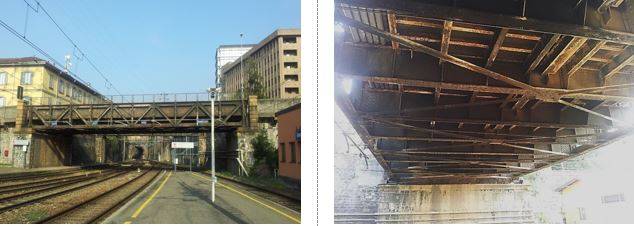
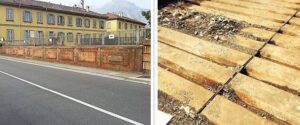
The project analysed below concerns the sizing and verification of the structure of a steel lattice bridge, located on Corso Matteotti in Lecco, at km 0+089 of the Lecco–Colico railway line, connecting two of the city's main roads. The construction of the "Badoni" railway overpass dates back to 1927 and was carried out by the Officine Badoni, which were based in Lecco itself.
The history of the Officine Badoni begins in the second half of the 18th century, when the first industrial settlement in the Lecco area was established, relating to a workshop with a forge and metalworking. From 1878, the company began producing iron structures such as bridges, canopies and roofing, and from the early 1900s it consolidated its product range and carried out a great many works, including the bridge that is the subject of this analysis.
In 2014, the Badoni bridge was in a state of deterioration, and one of the main issues concerned the bending in the structure caused by the passage of heavy vehicles.
The repair project involved the demolition of the deck slab and the construction of a new structure capable of bearing the loads required by the current regulations governing bridges.
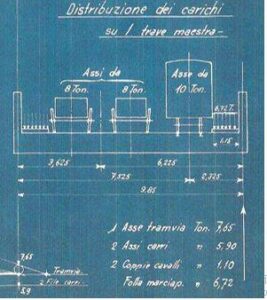
The loads considered in the bridge's original design refer to the 1916 regulations and are shown in the figure alongside.
The existing condition presented the following characteristics: the deck consisted of a layer of asphalt approximately 15 cm thick, a roadbed ballast weighing 420 daN/m², and Zores iron sections measuring 12×24 cm, weighing 80 daN/m²; the structure examined has a rectangular plan of 23.40 × 9.85 m.
The refurbishment was necessary in order to make the structure safe and bring it into line with the current loads passing over it; that is, it was necessary to comply with the provisions of Art. C8.4.3 of Circular No. 617 of 2 February 2009 (Instructions for the application of the "Technical Standards for Construction"), which covers all repair and strengthening works, provided that the overall behaviour of the structure is not significantly altered.
In order to assess the stress and deformation state of the structure, a 3D model was created using the DOLMEN Acciaio software, developed and distributed by CDM DOLMEN of Turin, using the geometry taken from the design drawings; for the material properties, in the absence of experimental testing, reference was made to the literature.
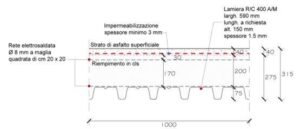
The project did not affect the load-bearing steel structure; instead, the focus was on the old deck, which was to be replaced with an OR 75/570 corrugated steel sheet, 1.5 mm thick and weighing 17.21 daN/m², together with additional longitudinal 12 mm diameter rebars.
The completion casting was carried out using lightweight aggregate concrete of the Leca type (concrete 1600 = 1700 daN/m³), reinforced with electrowelded mesh of 8 mm diameter and 20/20 spacing, covered by a waterproofing layer and a subsequent layer of asphalt approximately 4 cm thick (as shown in the previous image).
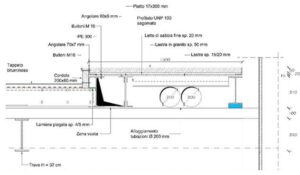
The pavements are 150 cm wide and consist of 15 mm thick steel plates stiffened in their plane by UPN 100 sections, which will rest on two new IPE 300 and 270 beams and on an existing beam composed of a 17×300 mm plate and four 60×9 mm angles. The empty area beneath the pavements will be used for secondary purposes, for example to house cables.
The objective was to achieve a deck that was lighter than the previous one and that offered high strength, without altering the statics of the structure.
The reduction in the weight of the structure can be seen as a numerical example: P (old deck) = 420 + 80 = 500 daN/m² P (new deck design) = (0.20 + 0.0195) × 1700 + 17.21 = 390.36 daN/m²
The designer, Eng. Pierluigi Muschiato of O&M Ingegneria in Acqui Terme (AL), carried out two assessments that were verified using both the analytical method and the experimental method, and then made a comparison between the two procedures.
Firstly, a FEM calculation model was created using the DOLMEN program; in this case, three models were run relating to three simulated load tests. As an illustrative example, the results obtained are reported for the load case relating to two trucks arranged one per lane, and for that relating to six trucks arranged three per lane.
Puoi scegliere di impedire a questo sito web di aggregare e analizzare le azioni che intraprendi qui. Ciò proteggerà la tua privacy, ma impedirà al proprietario di imparare dalle tue azioni e di creare un'esperienza migliore per te e per gli altri utenti.
You may choose to prevent this website from aggregating and analyzing the actions you take here. Doing so will protect your privacy, but will also prevent the owner from learning from your actions and creating a better experience for you and other users.


