The article describes the design of a prefabricated steel house in Cogorno, highlighting the use of a strong, seismic-resistant and quick-to-assemble metal frame on solid foundations.

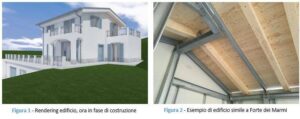

The following describes the design, by the firm O&M Ingegneria and dHw System, of a prefabricated residential building in the hilly locality of Cogorno. The area, surrounded by the River Entella, lies between the lower Val Fontanabuona and the Val Graveglia, east of Genoa, in a striking landscape set in the heart of the Ligurian Apennines, characterised by the countless valleys that run through it, the dense woodland and the slow flow of the rivers that empty into the Ligurian Sea opposite.
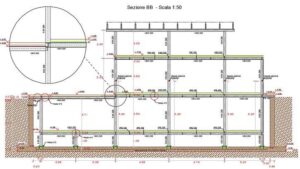
The residential building is a single-family home spread over three floors, one of which is a basement housing a garage. The entire structure will be built structurally in steel, with a plan measuring approximately 17.49 × 12.09 m and a maximum height of 11.32 m, with a pitched roof created by means of steel false rafters.
The project involves the construction of a frame composed of steel beams and columns, while the foundations will be created by means of a reinforced concrete raft 20 cm thick. This will allow the structure to rest on a solid, resistant surface that is not subject to particular moisture conditions, so as to minimise the problems associated with infiltration from below, thereby ensuring that the building is perfectly preserved over time. The ground floor of the structure is underground on three sides and, to protect the excavation that will be carried out on the plot, a reinforced concrete retaining wall will be built around the building.
The choice of steel and the innovative dry-construction system used by dHw System is due to the fact that they offer exceptional seismic properties, far superior to those found in other materials. Homes that use steel structures are able to absorb seismic energy, which is dissipated, safeguarding both people's lives and the integrity of the building.
In Italy, buildings constructed in steel — to date mainly intended for production and commerce — did not suffer structural damage following the earthquakes of 2009 in L'Aquila, 2012 in Emilia-Romagna and Lombardy, and 2016 in Lazio, Umbria and Marche. The efficiency of metal construction in the face of earthquakes lies in its extremely high ductility which, combined with a construction process based on prefabrication and dry connection, leads to the creation of lightweight structures subjected to more limited seismic actions. Secondly, steel is a high-quality material and allows short delivery times, thereby reducing investment costs; indeed, construction times are cut by 50–60%, making it possible to assemble the structure with great ease.
The method by which steel homes are built also helps to improve microclimatic living comfort, thanks to its thermal and acoustic insulation, lowering the costs of electricity and gas for heating the rooms, ensuring greater energy efficiency and making the building Class A. The risk of fire is also reduced, since dry-built steel structures have higher passive fire resistance than other industrialised construction systems that use different building materials.
Finally, the construction site of a steel structure is a "clean" site that employs skilled labour, with far more organised spaces than those associated with buildings made using other traditional technologies; it also offers the possibility of working even in confined spaces and unfavourable conditions, making it possible to carry out not only new-build projects but also extensions, vertical additions or restoration works with the lowest possible impact.
The frame of the home will consist of HEA 200 columns around the perimeter of the building and HEB 200 columns to support the ridge beam. The beams, on the other hand, will be made of HEA 200 sections for the perimeter main beams, IPE 200 for the internal main beams and IPE 160 for the secondary beams supporting the floors, which are made entirely of ISOBOX panels, with the exception of the garage area, where EGB 210/D composite corrugated steel sheets will be used.
The entire structure under examination was modelled with the aid of DOLMEN, a finite element calculation program produced and distributed by CDM DOLMEN of Turin. DOLMEN made it possible to verify both the reinforced concrete and the steel parts, and to design the steel connections, some details of which can be seen in the images below. DOLMEN also made it possible to carry out the geotechnical and structural verifications of the foundations and the earth-retaining walls.
Puoi scegliere di impedire a questo sito web di aggregare e analizzare le azioni che intraprendi qui. Ciò proteggerà la tua privacy, ma impedirà al proprietario di imparare dalle tue azioni e di creare un'esperienza migliore per te e per gli altri utenti.
You may choose to prevent this website from aggregating and analyzing the actions you take here. Doing so will protect your privacy, but will also prevent the owner from learning from your actions and creating a better experience for you and other users.


