The use of micropile retaining walls — the so-called "Berlin walls" — is evolving thanks to new materials and machinery, thereby making it possible to carry out deep excavations even in confined urban environments or in contact with buildings or infrastructure of great interest and economic value.

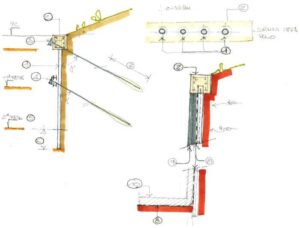
IMMAGINE 1: Parti componenti la paratia “berlinese”: 1. Micropali; 2. Cordolo testa-palo, 3. 1° ordine di tiranti; 4. 2° ordine di tiranti; 5. Seconda fase di scavo; 6. Infissione oltre il piano di scavo; 7. Lunghezza tirante aderente; 8. Guaina bentonitica; 9. Getto di controparete; 10. Platea di fondazione.
So-called "Berlin walls" can be of a "permanent" nature, when with the internal lining alone they become a permanent retaining structure, but they can also be temporary, useful only for the excavation, in cases where the definitive resistance to the thrust of the ground is then entrusted to the completion of the underground structures.
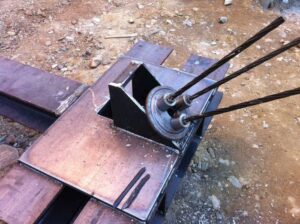
Likewise, the tie-rods that are installed to stabilise the retaining walls may be "permanent" if built in ground whose owner does not require their subsequent removal, or temporary if they cannot remain for the duration of the structure's lifespan because they are located beneath public land or private property whose owner does not intend to cede the rights to it.
The design of the retaining walls therefore consists in suitably balancing the thrust of the ground and its state of deformation through various factors such as: the inertia of the wall, its embedment length in the substrate beyond the excavation level, and the type and tension of the tie-rods or struts.
The combined application of these forces makes it possible to progressively create a structure that meets our needs in the particular situation in which it is applied.
The retaining structure we are discussing has certain construction features that make it perfect for these types of operations:
The component parts of the retaining wall are generally the following:
Often this type of excavation results in the interception of aquifer horizons, or simple water veins or leaks from the water/sewage system in the vicinity of our site; it is therefore necessary to build counter-walls capable of withstanding the hydraulic thrust and keeping the liquids outside the buildings.
Generally, a new reinforced concrete wall is built after laying a bentonite-type waterproof membrane, to be confined between the casting and the piles, or a thicker counter-wall in concrete admixed with waterproofing substances, which are proving highly reliable.
At this point I would like to show some successfully completed projects, each of which had significant challenges and required an original solution.
Excavation for the construction of the foundations and the underground levels of a residential building in a small area enclosed between an existing tall building, a major hydraulic structure and the presence of a railway embankment; the site was characterised by the impossibility of carrying out the classic prestressed tie-rods on some of its fronts.
Excavation carried out adjacent to other buildings or heavy infrastructure interferes with the pressure bulb developed in the ground by isolated direct foundations; usually the prestressed tie-rods serve to contain the lateral thrusts of the bulb that is cut into. In this case, it was necessary to resort to the construction of trestle struts to serve the same purpose.
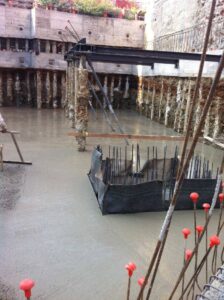
The second example of confined excavation that I bring to your attention concerns a deep excavation carried out in a central area adjacent to a busy municipal road, which had to be kept fully operational and in conditions of complete safety; in this case, the presence of springs in the fractured marly substrate entailed technological choices to withstand the water thrust and keep the building under construction dry.
Puoi scegliere di impedire a questo sito web di aggregare e analizzare le azioni che intraprendi qui. Ciò proteggerà la tua privacy, ma impedirà al proprietario di imparare dalle tue azioni e di creare un'esperienza migliore per te e per gli altri utenti.
You may choose to prevent this website from aggregating and analyzing the actions you take here. Doing so will protect your privacy, but will also prevent the owner from learning from your actions and creating a better experience for you and other users.


