The mixed steel–reinforced concrete structure was the solution chosen to seismically upgrade and refunctionalise a historic hotel in Santa Margherita Ligure. The project replaced the old reinforced concrete framework with steel frames, reinforced concrete cores and composite floor slabs, focusing on greater distributive flexibility, control of displacements, durability in the marine environment and operational safety.
The project tells the story of a case of architectural and seismic upgrading in which the structural choice becomes a decisive part of the building's refunctionalisation. In a historic hotel on the seafront of Santa Margherita Ligure, the previous reinforced concrete structure, considered too bulky and poorly suited to the new layout requirements, was replaced with a new mixed steel–concrete framework: bolted steel frames, reinforced concrete cores, composite floor slabs and a ventilated, waterproofed raft. The result is a system that is lighter, more flexible and more controllable under seismic action, with particular attention to durability, joints with the existing masonry and performance in the marine environment.
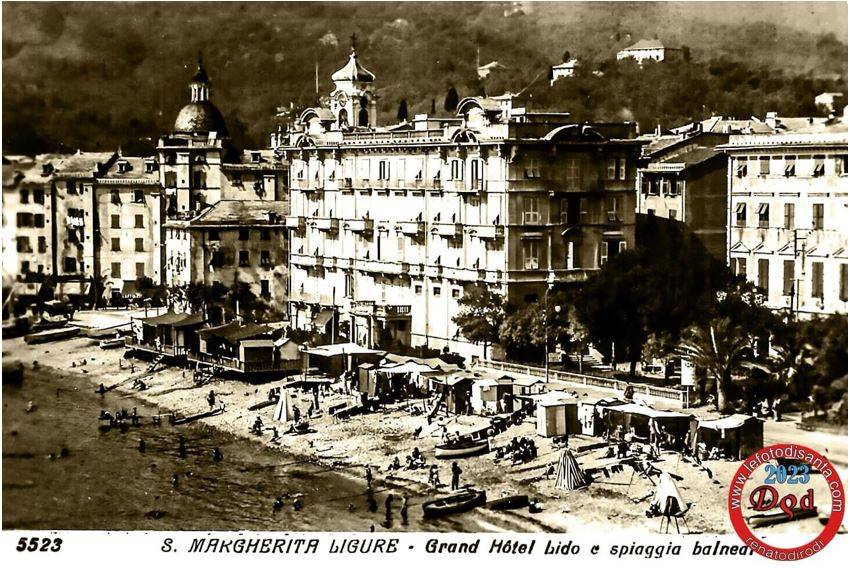
Cartolina d’epoca del Grand Hotel Lido di Santa Margherita Ligure: l’edificio originale sul lungomare oggi oggetto di ristrutturazione strutturale e riqualificazione architettonica. (Crediti: www.lefotodisanta.com)


The company "Lido Palace Hotel S.p.a." decided to renovate and upgrade the entire historic building of the former Hotel Lido — which will reopen under the name "Excelsior Palace Santa" — in accordance with the regulations in force regarding the removal of architectural barriers and seismic improvement; the building is located at the centre of the waterfront in Santa Margherita Ligure (GE), a famous resort on the eastern Ligurian Riviera.
It is a stately location and a historic building of importance to the urban fabric of Santa Margherita; over the years it had been heavily transformed from a hotel into a residence in the 1970s, through the construction of a cast-in-place reinforced concrete structure that severely limited the possible renovation aimed at restoring to the building the characteristics of a 5-star hotel, the tourist target to which the ownership aspires.
In 2020, the architectural, building-services and structural designs thus began, aimed at pursuing the objectives set:
In this short article, we will therefore discuss the load-bearing structure that was designed and installed; analysing the geometry of the existing structure, it was clear that the spacing and dimensions of the columns, as well as the coplanarity of the floors, posed problems for a modern and rational use of the spaces.
In plan, the building presented itself as an elongated rectangle with internal dimensions of about 43×11 m, composed of 1 basement level and 4 floors above ground.
At the end of a comparison between the various requirements, we chose a radical route, namely to remove in two phases the reinforced concrete structure with 30×50 cm columns spaced at 4.5 m, replaced with a slimmer, less bulky steel structure, meeting the environmental and seismic criteria, given that we are just a few metres from the sea.
Following the requests of the architectural designers, we therefore sketched out the design of a steel structure resting on a raft foundation, so as to keep the new floors coplanar with the layout of the external terraces, which are particularly important from an architectural standpoint.
We opted for a bolted structure with protective hot-dip galvanising 80 microns thick, entailing the minimum structural footprint, above all by creating a wing without intermediate columns; the new lateral columns were placed against the perimeter walls, so that the internal volume could be modelled according to future needs, without having to carry out further structural modifications.
Among the client's requests was the possibility of developing a fifth floor of suites, above which it would be possible to place, on the sixth floor, an area dedicated to housing building services as well as a ski bar entirely in steel and glass, designed to bear a crowding of people typical of a public venue; for this reason, the new structure contains a high number of vertical connections, 2 lift shafts, a stairwell and a goods lift built in reinforced concrete, in order to make the sixth floor and the current roof usable for the installation of catering activities.
After careful consideration, a mixed steel–reinforced concrete structural type was chosen, composed of the following elements: a plate foundation consisting of a ventilated raft foundation, made waterproof with additives inserted into the mix (we are practically on the beach, and the geology clearly indicates this), with a raised edge designed to house the building services and a ventilated cavity, as well as to support the steel columns.
The metal structure is made up of a series of plane frames (with main beams composed of steel and concrete with welded connectors and a clear span of 10.30 m, secondary beams of the IPE series at 1 m spacing, and a slab in Hi-bond corrugated steel sheet connected to the secondary beams with metal connectors at a rate of 4/m²) and columns of the HEA-HEB series that run from the foundation to the roof with bolted joints made outside the critical zone.
In practice, this resulted in the creation of a space completely free of obstacles, measuring 42×10 m; the seismic forces of each floor were discharged onto the 2 lift cores and 1 goods-lift core, which are entirely in reinforced concrete.
The structural design, after the preliminary sizing, was developed through the use of the Dolmen software, the structural calculation program that we have been using for 30 years now in the various versions subsequently developed.
The structure was calculated according to the NTC 2018 and Eurocode 5, building a three-dimensional FEM model with the Dolmen program, obtaining from it the information needed for the sizing and verification of the structure.
Given the wide spans and with reference to the seismic displacements of the metal structure compared with those of the perimeter masonry, a careful analysis of both vertical and horizontal displacements was carried out; the loads due to weather events were also hypothesised on the basis of the storm surge of November 2018, an occasion on which the values set by the regulations were exceeded.
Particularly demanding were the calculation and detailed design of the floor nodes that restrain the composite beam, since, in order to limit the vertical displacements, the floors were built in corrugated steel sheet with an internally reinforced completion casting.
Particular attention was devoted to the seismic analysis concerning the interaction between the perimeter masonry — which now constitutes only an infill — and the new structure; an effort was therefore made to create a joint that would allow the displacements of the two different structures while at the same time making the perimeter masonry stable.
This stabilisation was achieved by installing around 1,000 steel connectors in B450C, 1 m in length, embedded in the floor casting and distributed across the 4 floors, as well as 8 pairs of tie-rods (chains) with external plates at the corners.
In the zone where the connector stresses develop, the historic masonry (built in local stone) was reinforced with a strip of mineral-matrix fibre reinforcement in galvanised steel fibres, placed along the internal face of the masonry.
Puoi scegliere di impedire a questo sito web di aggregare e analizzare le azioni che intraprendi qui. Ciò proteggerà la tua privacy, ma impedirà al proprietario di imparare dalle tue azioni e di creare un'esperienza migliore per te e per gli altri utenti.
You may choose to prevent this website from aggregating and analyzing the actions you take here. Doing so will protect your privacy, but will also prevent the owner from learning from your actions and creating a better experience for you and other users.


