This describes a restoration project on a building constructed partly in raw earth (cob/adobe): the building represents a not insignificant share of the existing structures found in the rural areas of the Piedmont countryside. The project involved a series of operations aimed at improving the static and seismic conditions of the existing building, in order to ensure its safety and prevent future local collapses.
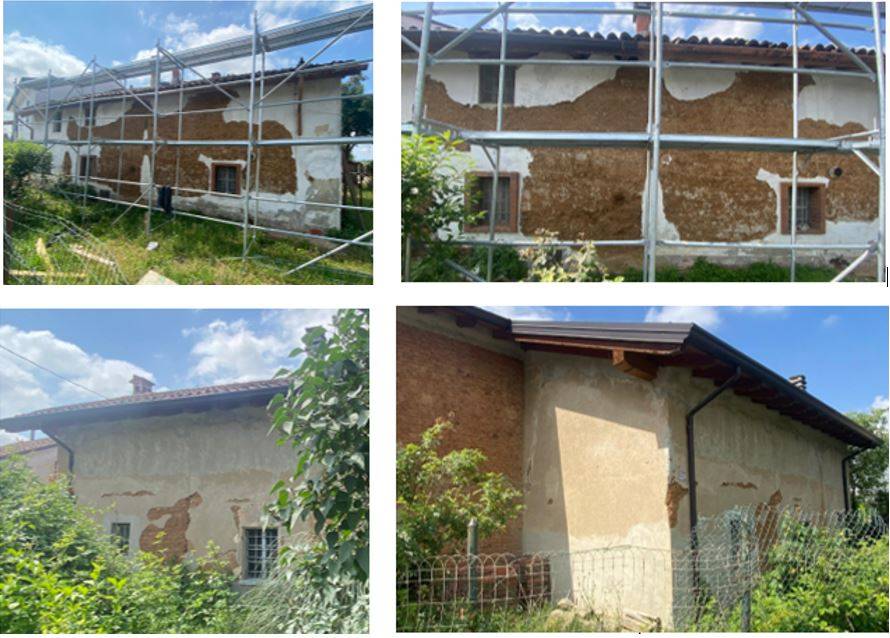
Esempi di alcuni edifici nella frazione di Spinetta Marengo (AL) di edifici realizzati in parte in terra cruda. (Crediti: P. Muschiato)



In the architectural landscape of the agricultural area around Alessandria, particularly in the lowland zone known as the "Frascheta" (an area that extends mainly across the countryside between Alessandria, Tortona and Novi Ligure, and in particular in the municipalities of Bosco Marengo, Pozzolo Formigaro and Frugarolo), there are many examples of houses built in raw earth, also improperly called "Trunere" or simply, in the Alessandria dialect, "Cà d'tèra". In this area there are numerous examples of buildings constructed in raw earth, from houses to farmsteads, from churches to even schools and town halls.
In the Frascheta, therefore, as in the plain of Marengo, earth has always been used by farmers to build their own houses. The earth used in these areas has a characteristic red colour, due to the strong presence of iron minerals contained in the clay.
Among the main working techniques used to build load-bearing earth walls, especially in the Alessandria area, are "pisé" (rammed earth) and "adobe".
The first, in particular, is based on the construction of walls with moistened and rammed earth — that is, compressed layer by layer inside a wooden formwork — in order to obtain the so-called raw brick. The second technique, on the other hand, was adopted only marginally in the Frascheta area.
Among the factors that most affect the deterioration of walls built with this technique, beyond the classic construction defects (linked to a poor knowledge of the construction process on the part of those who built this type of building in the past), are:
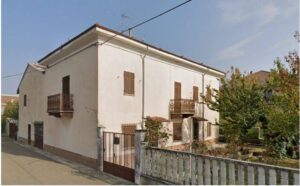
The building in question, for residential use, is located precisely in the province of Alessandria, specifically in the hamlet known as Spinetta Marengo. Its construction undoubtedly predates 1967, although no definite documents have been found to prove this. In its current state, the building had an L-shaped plan, since in all likelihood, compared with the original layout, two separate buildings had been merged, also identifiable by the two separate roofs of different shapes (one hipped and the other pitched). Overall, the building was spread over 3 floors above ground and one basement level.
Structurally, the building was characterised by load-bearing masonry of solid bricks interspersed with portions in raw earth, with floors partly vaulted in masonry and partly with small vaults and iron joists, while the roof is composed of a timber framework and a covering of clay roof tiles. There is no widespread foundation raft, but only a widening of the load-bearing walls below the ground surface.
The inspections carried out on site had highlighted the very poor state of conservation of the building, as a consequence of the poor maintenance carried out during the years in which the building itself had remained uninhabited. In particular, the visual analysis carried out had revealed a series of problems, including:
From a structural standpoint too, the building presented several critical issues, both static and dynamic, which made it vulnerable to seismic actions.
Several walls, in fact (both along the internal and external façades of the building), showed significant cracking, attributable to the poor mechanical characteristics of the masonry, to the absence of tension-resistant elements at the floor levels (ring beams, tie-rods, etc.) and to the presence of thrusting elements (vaults and roof beams), as well as to settlement of the foundation level. The vaults also presented some problems.
In particular, those that thrust against the external walls show cracking on the intrados at the midspan. Again, it was hypothesised that these could be attributed to the poor capacity of the walls on which they rest to counteract the horizontal static thrusts generated by the vaults, thus causing the consequent relaxation of the vaults themselves.
The project, as well as being aimed at architectural renovation as required by the client, first and foremost involved a series of operations aimed at improving the static and seismic conditions of the existing building.
The main purpose, therefore, was to reduce the building's intrinsic vulnerabilities, restoring the pre-damage configuration of the deteriorated parts and also increasing the strength and/or ductility characteristics of the damaged elements.
In addition, given the previous settlements that had occurred, another significant aspect concerned the safety of the building in order to prevent future local collapses, especially differential ones.
The structural works carried out therefore involved:
For the calculation of the stresses and for the verification of the reinforced concrete beams, columns, floors and foundations, a finite element solver was used, employing as the calculation program: DOLMEN WIN (R), version 23 of 2023, produced, distributed and supported by CDM DOLMEN srl, based in Turin, Via Drovetti 9/F.
Puoi scegliere di impedire a questo sito web di aggregare e analizzare le azioni che intraprendi qui. Ciò proteggerà la tua privacy, ma impedirà al proprietario di imparare dalle tue azioni e di creare un'esperienza migliore per te e per gli altri utenti.
You may choose to prevent this website from aggregating and analyzing the actions you take here. Doing so will protect your privacy, but will also prevent the owner from learning from your actions and creating a better experience for you and other users.


