The following describes the works required for the reconstruction and safety upgrading of the bathing structures in the area known as the "Seafront" of the Hotel Excelsior Palace in Rapallo — structures damaged by the exceptionally intense weather events that occurred on 29 and 30 October 2018.
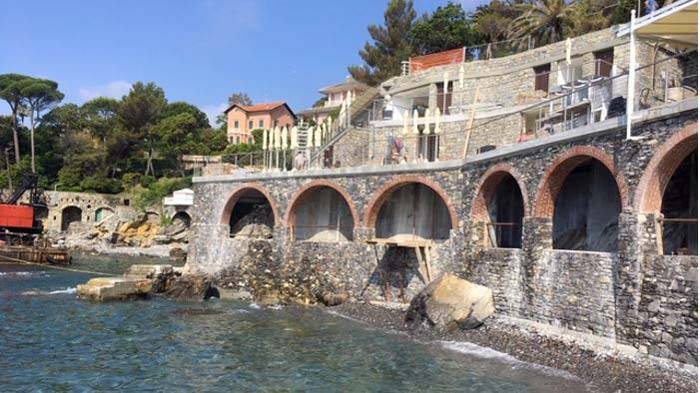
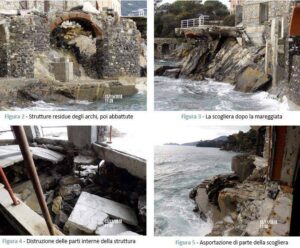
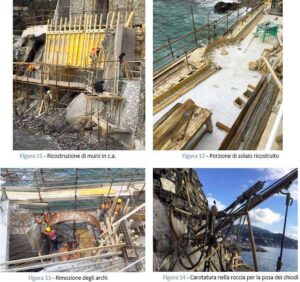
The Hotel Excelsior Palace stands next to the port of Rapallo and is located on the promontory; its bathing structures, consisting of terraces housing swimming pools, bars and restaurants, were set on the seafront cliff and had been built simply by resting on it.
During the day and night of 29 and 30 October 2018, a powerful storm surge fed by a sirocco wind struck Liguria; in particular, in the Gulf of Tigullio, the coast running from Rapallo to Portofino was hit, exposed precisely in that direction and with a seabed bathymetry that contributed to the development of very powerful waves. The weather event grew in intensity over the course of the day: the wind reached 170 km/h and the height of the waves striking perpendicularly to the hotel's structures was 10.30 m, roughly the level of the upper road leading to Portofino. The event proved catastrophic along the entire coastline and, above all, on this promontory, to the extent that it brought down, over a 300 m stretch, the breakwater of the port of Rapallo, which following a storm surge in 2000 had already been rebuilt 1.30 m higher, bringing it to a height of 6.5 m.
Once the storm surge had subsided, it could be seen that all the hotel's seafront structures (the restaurant, the bathing establishment, the swimming pool, the gym area, the cabins and the jetty) were completely destroyed. The horizontal structures, as well as the vertical walls, had been removed, and the force of the waves had torn away the very rock benches on which they rested and had hurled large boulders onto the upper levels.
The damage to the structures was significant; below is a summary of the areas affected:
The only part that remained intact was the wall built in the summer of 2018: a stretch of windbreak wall and a double-girder floor slab had been constructed at a level of 10.00 m, bolting the wall to the rock below. This portion of the structure had been appropriately calculated; indeed, from an energy standpoint, the waves matched the design predictions made using the Goda method employed; the same structural principles were also applied in this new reconstruction.
The new state of the site was surveyed using "laser scanner" technology.
The intention of the hotel's ownership was to remedy the damage suffered immediately and to rebuild in such a way as to have the hotel fully operational for the 2019 summer season. In order to restore the entire area to its original tourist use, it was necessary to rebuild the affected structures, giving them sufficient strength to withstand the stresses induced by any future exceptional storms. It is clear that the reconstruction work had to be as faithful as possible to the original, in terms of both geometry and the exposed cladding material.
In the project, particular attention had to be paid to assessing the environmental stresses to which the works are subjected and to referring to the relevant documentation produced for the earlier works.
Owing to the location, the preparation and reinforcement of the construction site (which extended over a front of about 150 m) proved particularly demanding; the area to be rebuilt ran along the road leading from Rapallo to the hamlet of San Michele, at a height of about 12 metres above sea level.
For this reason, it was necessary to install two tower cranes, and the operating machinery was lowered into the site by means of them. The operation of removing the debris was also particularly demanding: for the heaviest and largest pieces, the intervention of a suitably equipped pontoon was required.
The following structures were chosen:
Particular attention was devoted to the design and execution of the anchor bolts, which constitute the truly crucial point of the structure's stability, since they must transmit the dynamic stresses of the structure to the rock mass supporting it. This system is organised into two series of bolts: the first with bolts 4.50 m long and 40 mm in diameter, the second with bolts 1.50 m long.
The bolts were inserted by reinforcing the rock with a larger-diameter roto-percussion drill; the bars are made of B450 steel, and a specially designed cement mixture — using superplasticisers and a low water content, slightly expansive — was pressure-cast into the hole.
In all, around 400 bolts were installed, distributed according to a precise pattern; some of these were used to stabilise rocky sections that had been mobilised by the wave motion, or to build tie-rods to restrain the slab of the walkway towards the port.
The steel structures that were installed were made with hot-dip galvanised steel members and bolted connections; on-site welding was avoided.
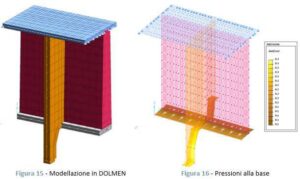
The structural scheme adopted for the calculation is that of a structure composed of vertical walls and horizontal plates restrained to the ground by rigid links, which served to derive the stresses on the bolts. Particular importance was given to the calculation of the stresses, especially the thrust required by the NTC 2018 for structures in seismic zone 3.
The structure was calculated using the DOLMEN program, produced and distributed by CDM DOLMEN SRL of Turin, by means of a dynamic modelling that made it possible to obtain results in terms of stresses, material tensions and displacements.
The reinforced concrete wall is founded on a rectangular base of cast-in-place reinforced concrete 30 cm thick, calculated as reacting on a Winkler elastic soil. It is set on the existing rocky profile, in some points re-profiled and regularised for the occasion, and is restrained to the rock by means of the bolting described earlier. The wall and the stiffening internal walls were modelled with membrane shells whose thickness varies from a minimum of 30 cm for the base to a maximum of 100 cm for the abutment.
The checks on the concrete and the reinforcement were carried out at the Ultimate Limit State, as required in chapter 7.2 of the NTC 2018. The average values of the ground load are everywhere lower than the limit load relating to the type of rock present.
Puoi scegliere di impedire a questo sito web di aggregare e analizzare le azioni che intraprendi qui. Ciò proteggerà la tua privacy, ma impedirà al proprietario di imparare dalle tue azioni e di creare un'esperienza migliore per te e per gli altri utenti.
You may choose to prevent this website from aggregating and analyzing the actions you take here. Doing so will protect your privacy, but will also prevent the owner from learning from your actions and creating a better experience for you and other users.


